Check your BDNF levels with these clinical blood panels
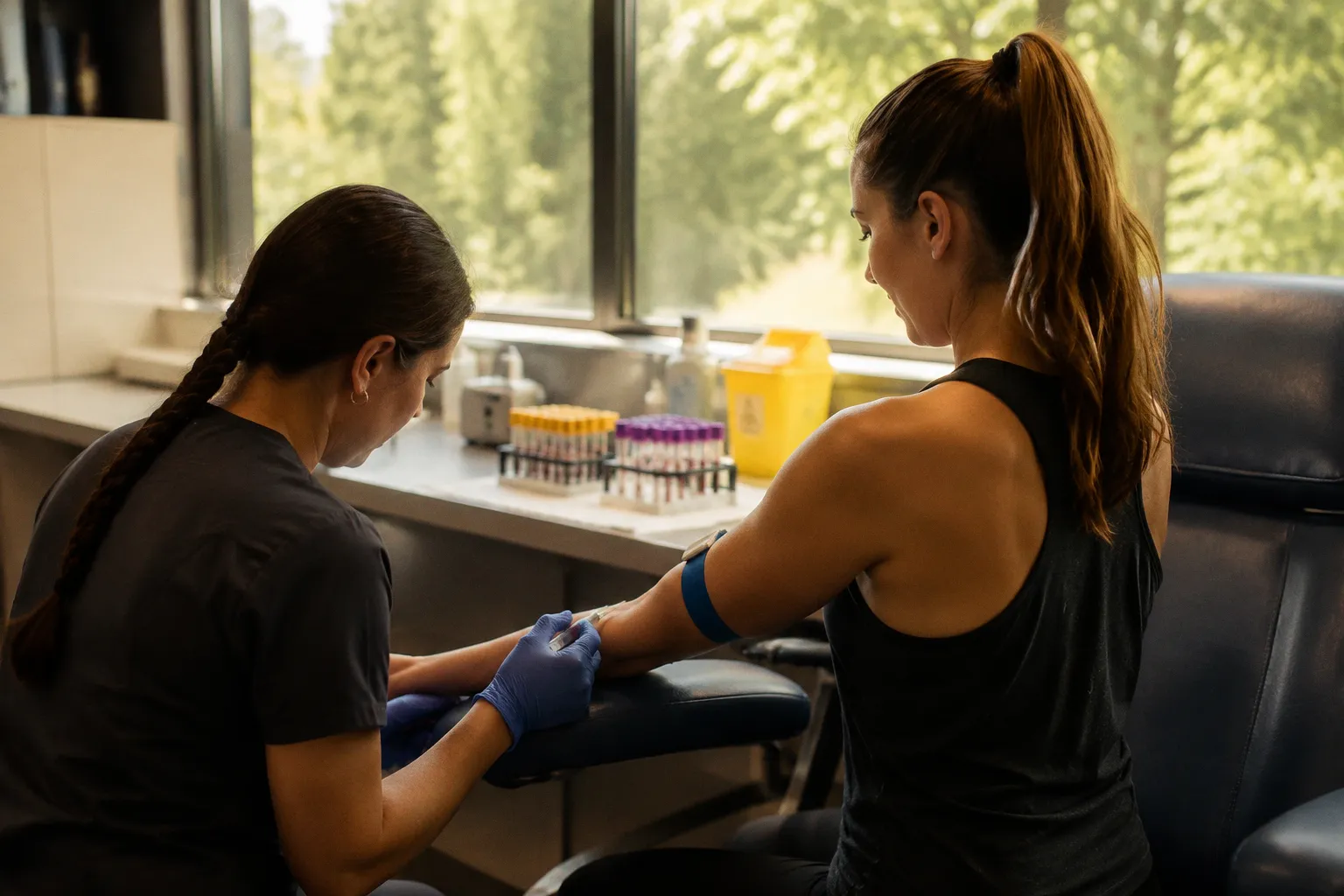
The first time I held a vial of my own blood in a small private lab in Zurich, I had the strange sensation that I was holding a letter addressed to my own nervous system.
Clara Hastings·Updated: June 16, 2026·13 min read
# Beyond the Brain: Navigating BDNF Blood Testing for Cognitive Optimization
BDNF lives in two worlds at once: it belongs to the brain, and yet most of what we can measure dwells quietly inside our platelets, waiting to be read.
It is this dual existence that makes checking your BDNF levels with these clinical blood panels such a strange and beautiful pursuit. The molecule is real, the science is firm, and the literature is rich. But the act of testing it draws a thin line between what we can know and what we must, for now, simply feel.
The Platelet Paradox: Why Serum BDNF Differs from Brain Concentrations
The story of BDNF begins, as so many biological stories do, in a place we cannot easily visit. Inside the brain, BDNF is a gardener. It tends the synaptic garden, pruning connections that no longer serve and coaxing new ones into bloom. It is one of the principal architects of neuroplasticity — the brain's capacity to rewire itself in response to experience, learning, and even injury. Without it, memory falters, mood dims, and the extraordinary flexibility that defines a healthy nervous system becomes brittle and slow.
What surprised me, when I first read deeply about this molecule, was how much of it lives outside the brain entirely. Platelets — the tiny, anucleate cell fragments most famous for their role in clotting — store approximately 99 percent of the BDNF found in peripheral blood. They carry it like a hidden library, releasing it only when the clotting cascade begins to unfold. This means that the moment blood leaves the vein and begins to clot in the collection tube, the BDNF count begins to climb. Serum, the liquid that remains after clotting, is therefore significantly richer in BDNF than plasma, the fluid collected when clotting is prevented. It is a small procedural detail with enormous interpretive consequences.
This is the platelet paradox: the very act of trying to measure BDNF in the blood changes the quantity we are trying to measure. The phlebotomist in Zurich understood this without my needing to explain it. She drew the sample quickly, handled it gently, and sent it on its way to be processed by ELISA — the enzyme-linked immunosorbent assay that remains, for all its limitations, the most common method for quantifying circulating BDNF. The result was a number somewhere in the 10 to 50 ng/mL range, which is where most healthy adults tend to land, depending on the assay and the lab. But holding that number in my hand, I could not honestly tell whether it was a message from my brain or simply a chorus of platelets singing in their own language.
The honest answer, as the research literature makes clear, is that we still do not know. The blood-brain barrier is famously selective, and whether peripheral BDNF concentrations reflect central nervous system concentrations is an open question. For now, what we measure in the blood is a shadow — sometimes long, sometimes short — of the garden inside the skull.
Navigating Specialized Labs: Why Standard Panels Miss the Mark
If you walk into a primary care clinic and ask for a BDNF test, you will most likely be met with a gentle, puzzled expression. This is not because the clinicians are uninformed. It is because BDNF testing is not part of the standard repertoire. A complete blood count, a comprehensive metabolic panel, a lipid profile — these are the workhorses of routine medicine, refined over decades to be reproducible, standardized, and clinically actionable. BDNF belongs to a different category entirely. It lives in the territory of research laboratories and specialized functional medicine practices, where the work is exploratory rather than diagnostic, and where the question of what a number means often outruns the certainty of what it means.
Routine blood work will not find BDNF. To measure it, you must leave the familiar clinic and enter the quieter rooms of specialized research.
This is not a failure of medicine. It is, rather, an honest reflection of where the science stands. BDNF was first characterized in the 1980s, and the bulk of what we know about it comes from animal studies, postmortem human tissue analyses, and a growing body of indirect measurement in living humans. There is no universal reference range for serum BDNF, no clinical cut-off below which a diagnosis becomes possible, no threshold above which a person can be told their brain is, in any meaningful sense, optimal. What specialized labs offer is the capacity to generate a number at all — a number that, when read carefully and contextualized thoughtfully, can become a single data point in a much longer conversation.
The practical reality, for someone curious about checking BDNF, is that the path runs through niche providers. Some universities offer testing through their research arms. A handful of commercial functional medicine labs process samples for clinicians who are willing to interpret them. Costs vary widely, turnaround times are often longer than a routine panel, and the results arrive without the comforting red-and-green reference ranges that standard labs provide. What you receive instead is a single number, an assay method, and a great deal of silence around what to do with it.
I have ordered BDNF tests three times in the last four years. Each time, the number was different. Each time, the lab report told me almost nothing I could act on directly. And each time, I learned something — not about my brain, exactly, but about the strange, humbling process of trying to listen to a molecule that is not yet in the habit of being heard.
Interpreting the 10–50 ng/mL Range: Variables That Skew Your Data
The first thing to understand about the 10 to 50 ng/mL range is that it is not really a range at all — it is a sketch. Different assays, different sample handling protocols, and different laboratory calibrations can produce numbers that look similar on paper but carry very different meanings. One lab's 22 ng/mL is not necessarily another lab's 22 ng/mL. This is not a flaw unique to BDNF testing; it is a feature of any biomarker that has not yet been standardized across the field. But it does mean that the most honest thing you can do with a single BDNF number is to refuse to treat it as a verdict.
| Variable | How It Influences Serum BDNF | Practical Implication |
|---|---|---|
| Sample type (serum vs. plasma) | Serum is significantly higher due to platelet release during clotting | Compare only same-matrix results across time |
| Time of day | BDNF follows a circadian rhythm, with peaks and troughs across the 24-hour cycle | Test at the same hour each time for valid comparison |
| Recent exercise | A single aerobic session can transiently raise circulating BDNF | Avoid intense exercise for 24–48 hours before testing |
| Sleep quality | Poor or shortened sleep can lower measured values | Track sleep for several nights before drawing blood |
| Age and sex | Levels vary across the lifespan and between men and women | Interpret results relative to a comparable demographic baseline |
| Assay method | Different ELISAs produce systematically different values | Stay with the same lab and platform across all tests |
When I look back at my own three measurements, I can see the fingerprints of these variables in the noise. The first test, taken after a season of long alpine walks and consistent sleep, returned a comfortable mid-range number. The second, drawn during a period of travel and fragmented rest, was noticeably lower — though whether this reflected my brain, my platelets, or my sleep schedule, I cannot say. The third, taken after a week of careful recovery and slow morning routines, returned closer to the first. The temptation, of course, is to construct a narrative: this was good, that was bad, this regimen is working, that one is not. The honest interpretation is humbler. A single number, drawn from a molecule with a short circulating half-life, is more like a photograph of weather than a record of climate.
A single BDNF number is a photograph of weather, not a record of climate. To learn anything real, you must learn to take the same photograph in the same light.
This is why, for anyone considering checking your BDNF levels with these clinical blood panels, the most valuable practice is repetition under controlled conditions. The same lab. The same time of day. The same pre-test routine. Several data points, taken across weeks or months, begin to sketch a shape. One data point, however, is just a pebble in a stream.
The Impact of Circadian Rhythms and Acute Stress on Single-Point Measurements
There is a particular kind of patience required to measure a molecule whose presence in the blood ebbs and flows with the hour. BDNF has a relatively short half-life in circulation, and its levels are sensitive to a long list of acute influences: the cortisol awakening response, the small inflammation of a tough workout, the metabolic echo of last night's dinner, the quiet stress of a hard morning. A venous blood draw is itself a small stressor, and the body's response to the needle is part of what gets measured. To pretend that a single point on this curve captures a stable property of the body is, I think, a kind of small self-deception.
What I have come to value, after several years of paying close attention, is the practice of contextualizing the draw. I note the previous night's sleep, the morning's movement or stillness, the presence or absence of caffeine, the general texture of the week. None of this appears on the lab report, but all of it lives inside the number. Without it, the number is a sentence without grammar. With it, the number begins, slowly, to mean something.
This is also where the concept of allostatic load becomes quietly important. Allostatic load is the cumulative wear that repeated stress places on the body's regulatory systems — the slow, almost invisible tax that chronic tension, fragmented sleep, and relentless cognitive demand levy on the nervous system. BDNF sits at the heart of the body's response to this load. It is part of how the brain maintains its capacity to adapt, to recover, to find new patterns when the old ones no longer work. Measuring circulating BDNF, in this light, is not a direct window into the brain's adaptive capacity, but it is a faint echo of the systemic conditions in which that capacity either flourishes or falters.
If I were advising a friend who wanted to begin tracking this molecule — and I have advised several — I would suggest a quiet, almost ritualistic approach. Pick a season of relative stability. Test at the same hour, ideally mid-morning, after a familiar breakfast. Sleep well the night before. Avoid the gym for two days. Hydrate gently. Repeat in two to three months, under the same conditions, in the same lab. Over a year, you may accumulate four data points, each one a small photograph taken in the same light. From these, a shape may emerge — not a diagnosis, not an answer, but a pattern. And patterns, over time, are how the body begins to teach us what it needs.
Beyond Testing: Leveraging Aerobic Exercise as a Proven BDNF Modulator
There is a peculiar relief in arriving at the part of the conversation where the science is not only clear, but also deeply embodied. When it comes to actually moving the needle on circulating BDNF, the most consistent and well-documented non-pharmacological intervention is, simply, aerobic exercise. Walking, cycling, swimming, dancing — any sustained movement that elevates the heart rate and sustains it for a meaningful interval has been shown, across dozens of studies, to increase circulating BDNF levels. The effect is acute and transient, but it appears to be cumulative. People who move regularly tend to have higher resting BDNF levels than people who do not.
I have come to think of this as the body's most honest arithmetic. The brain does not respond primarily to intentions, supplements, or measured numbers on a lab printout. It responds to what the body actually does, repeatedly, across days and seasons. A forty-minute walk through the woods, a slow swim in cold water, a long afternoon of gardening — these are not lifestyle accessories. They are, in a very real physiological sense, the conditions under which BDNF is made available, used, and replenished. For anyone interested in preparing their body and mind for the next chapter of learning, the foundational practice is not a test. It is the rhythm itself.
This does not mean testing is useless. There is real value in the act of measuring, even when the measurement is uncertain. A number, even an unreliable one, can serve as a kind of mirror — a way of paying attention, of marking time, of noticing when the body is quietly drifting toward something different. The mistake is to confuse the mirror with the face. The face is the practice: the sleep, the movement, the slow unfurling of attention that allows a nervous system to feel safe enough to grow. The mirror is the lab report: useful, partial, and best held lightly.
I think often about the ritual of the early morning blood draw — the empty clinic, the soft hum of the centrifuge, the careful hands of the phlebotomist. It felt, in those quiet moments, as though I was participating in something older than medicine: the simple, ancient act of trying to know oneself through one's own fluids. We have been doing this for centuries, with humors and pulses and urine charts. We are still doing it now, with ELISA plates and circulating neurotrophins. The molecules change. The questions do not. How am I? What is becoming of me? Is my inner garden, in some way I cannot see, being tended?
The honest answer is that the blood can show us a few things, and hide many more. But the body, if we listen to it through the practice of sleep and breath and sustained movement, will tell us the rest. There is a kind of down-regulation that happens when we stop chasing numbers and start attending to cadence — the slow, restorative rhythm of a life lived in closer conversation with its own physiology. It is here, in the patient practice of that rhythm, that the brain's resilience quietly returns, not because we measured it, but because we made, day after day, the conditions in which it could grow.
The mirror is the lab report. The face is the practice. We do not grow the garden by photographing it.
In the end, checking your BDNF levels with these clinical blood panels is less a measurement than a meditation — an invitation to sit with the body's mysteries, to honor what can be known, and to tend, with patient attention, to the much larger garden that the blood only ever whispers about.