Compare circadian rhythm pronunciation in US and UK English
The phrase “circadian rhythm” is common in sleep science, recovery protocols, and longevity discussions. It is also a phrase that many speakers read more often than they hear.
Brian Woodward·Updated: July 01, 2026·13 min read
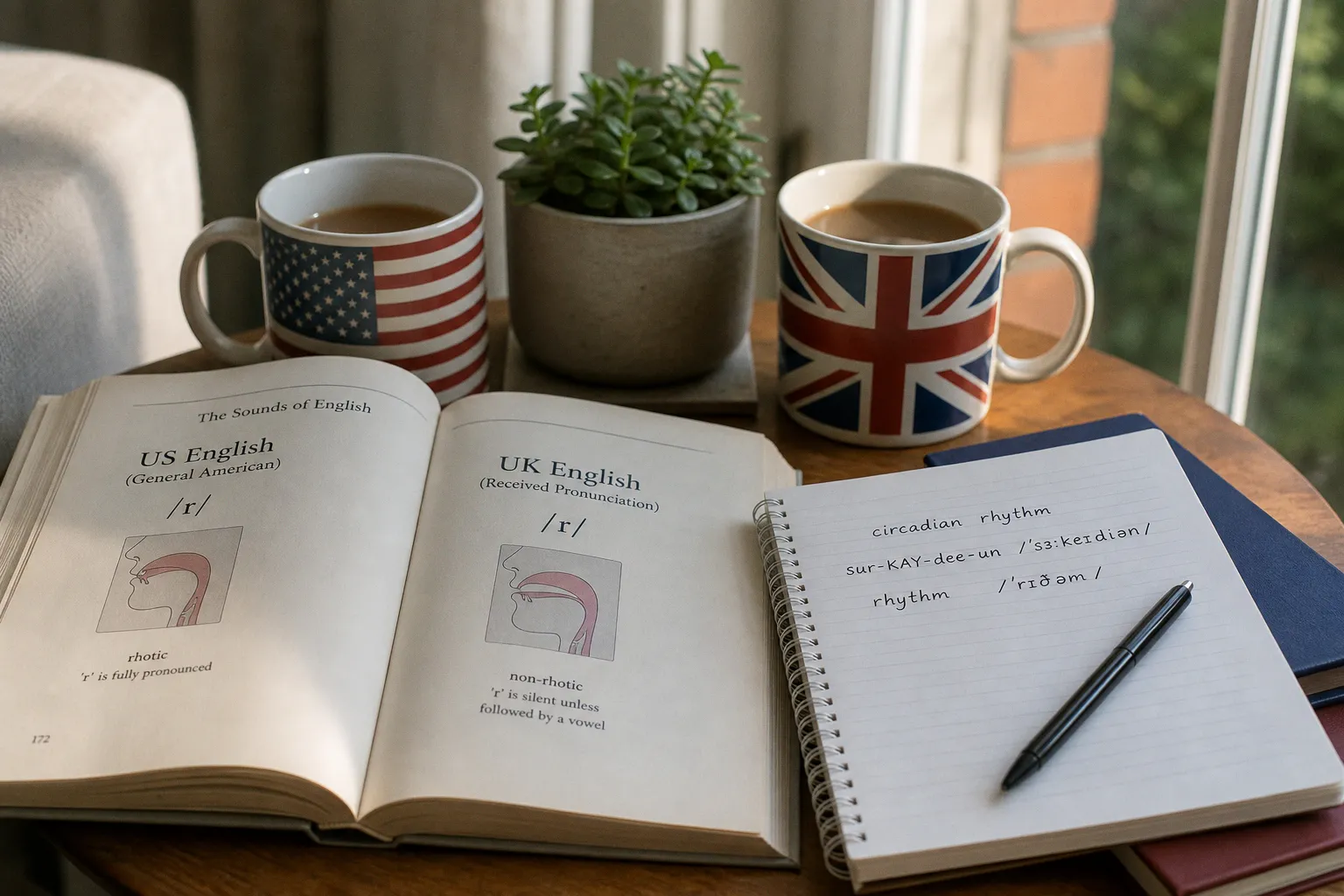
The central point is simple. The stress pattern does not change between standard US and UK English. The primary stress in “circadian” falls on the second syllable: sur-KAY-dee-un. “Rhythm” is also stable: RITH-um, with a voiced “th” sound. The dialect difference is not in the timing of the word. It is mainly in the treatment of the “r” sound and the vowel quality before it.
Decoding the phonetic structure of “circadian”
“Circadian” is a four-syllable word:
1. cir
2. ca
3. di
4. an
In a practical pronunciation guide, it is usually rendered as:
sur-KAY-dee-un
The second syllable carries the primary stress. That matters more than small accent differences. If the stress moves to the first syllable or the third syllable, the word becomes harder to recognize, even if the individual sounds are otherwise close.
In phonetic notation, the standard forms are:
| Dialect | IPA pronunciation | Practical rendering |
|---|---|---|
| US English, General American | /sɚˈkeɪ.di.ən/ | sur-KAY-dee-un |
| UK English, Received Pronunciation | /sɜːˈkeɪ.di.ən/ | suh-KAY-dee-un / sir-KAY-dee-un depending on transcription style |
The distinction is technical but audible. In General American, the first syllable contains an r-colored vowel. The “r” is pronounced. In Received Pronunciation, the “r” is generally not pronounced unless followed by a vowel in connected speech. The result is a longer central vowel, closer to /ɜː/.
The second syllable, KAY, is the anchor. It should be clear, open, and stressed. The third syllable, dee, is lighter. The final syllable, un, should not be overbuilt into a separate heavy ending.
The stress is the stable biomarker of the word. Dialect modulates the vowel; it does not relocate the emphasis.
The phrase then continues with “rhythm,” a two-syllable word:
RITH-um
In IPA, it is:
/ˈrɪð.əm/
This pronunciation is essentially the same across standard US and UK English. The first syllable is stressed. The “th” is voiced, as in “this,” not voiceless as in “thin.” The spelling is inefficient, but the sound is compact.
US General American: the rhotic approach
In General American English, “circadian rhythm” is typically pronounced:
/sɚˈkeɪ.di.ən ˈrɪð.əm/
sur-KAY-dee-un RITH-um
The defining feature is rhoticity. American English normally pronounces the “r” wherever it appears in spelling, including after a vowel. In “circadian,” this affects the first syllable. The speaker does not say a clean “suh” and move on. The vowel is r-colored: sur.
A careful US articulation proceeds in sequence:
1. Start with /sɚ/
The tongue moves into an r-colored vowel. The sound is not a full separate “sir” in a heavy sense, but it contains audible rhoticity.
2. Stress /ˈkeɪ/
The second syllable is the highest-energy component. This is the syllable most likely to restore intelligibility if the rest of the word is imperfect.
3. Release /di/
The third syllable is light and clean. In casual speech, it may be slightly reduced, but it should not disappear.
4. Finish /ən/
The final syllable is unstressed. It should remain short.
5. Move into /ˈrɪð.əm/
“Rhythm” begins with a pronounced /r/. The “th” is voiced: /ð/.
The US pattern is therefore relatively explicit in its “r” sounds. “Circadian rhythm” contains rhoticity at the beginning of both words: the r-colored vowel in “circadian,” and the initial /r/ in “rhythm.”
There is one subtlety in casual American speech. The “t” issue mentioned in some pronunciation descriptions is less central here because “rhythm” contains no pronounced “t” in standard articulation. The important consonant is the voiced “th” /ð/. Some speakers may make the transition through the middle of “rhythm” more forcefully; others keep it very soft. But the standard target remains /ˈrɪð.əm/.
For wellness and sleep discussions, this is not trivial pedantry. Terms like “circadian rhythm,” “sleep architecture,” and “heart rate variability” often move between clinical literature, podcasts, coaching environments, and consumer devices. A term that is mis-stressed can sound less credible, especially in a technical conversation. Precision in language is not the same as precision in physiology, but the two often travel together.
UK Received Pronunciation: vowel quality and non-rhoticity
In Received Pronunciation, the same phrase is usually pronounced:
/sɜːˈkeɪ.di.ən ˈrɪð.əm/
suh-KAY-dee-un RITH-um
or, in some teaching guides, sir-KAY-dee-un RITH-um, with the warning that the “r” is not pronounced as in American English.
The first syllable is the main difference. RP is non-rhotic. This means that an “r” after a vowel is usually not pronounced unless the next word begins with a vowel sound. In “circadian,” the “r” modifies the vowel quality rather than emerging as a distinct rhotic consonant.
Compare the first syllable:
| Feature | US General American | UK Received Pronunciation |
|---|---|---|
| First syllable of “circadian” | r-colored /sɚ/ | non-rhotic /sɜː/ |
| Practical sound | “sur” | “suh” with a longer central vowel |
| Primary stress | second syllable | second syllable |
| “rhythm” | /ˈrɪð.əm/ | /ˈrɪð.əm/ |
| Main perceptual difference | audible “r” coloring | smoother vowel without pronounced post-vocalic “r” |
This distinction is not a hierarchy. It is not that one form is more correct. Both are standard within their dialect systems. The error is to mix assumptions: for example, to use a UK-style non-rhotic first syllable while trying to imitate a US accent, or to insert a hard American “r” into RP speech when that is not otherwise the speaker’s accent.
The same logic applies in technical domains outside biology. Terminology carries operational meaning, whether the subject is sleep timing or credit rates and debt management. The best approach is not theatrical correctness. It is consistency with the system being used.
For UK speakers, the main target remains the second syllable. The word should not become SIR-ca-dee-an with first-syllable stress. Nor should it become cir-ca-DIE-an. The biological term derives from “circa” and “diem,” but pronunciation in modern English follows its own stabilized pattern: sur-KAY-dee-un or suh-KAY-dee-un, depending on dialect.
Standardizing “rhythm”: why the second word is less variable
“Rhythm” is orthographically hostile. It has no conventional written vowel in the first syllable, and the “thm” cluster looks denser than it sounds. In speech, however, it is stable:
RITH-um
/ˈrɪð.əm/
The first syllable carries stress. The vowel is /ɪ/, as in “sit.” The “th” is voiced /ð/, as in “this.” The final syllable is a reduced /əm/.
The most common mistake is to pronounce the “th” as voiceless /θ/, as in “thin.” That produces something closer to RITH with a sharper dental sound. The standard word uses the softer voiced sound. The vocal folds vibrate during /ð/. A simple test is to place fingers lightly on the throat and compare “thin” with “this.” “Rhythm” belongs with “this.”
Another error is to overpronounce the final syllable: RITH-um should not become RITH-oom. The second syllable is reduced. It completes the word, but it does not compete with the first syllable.
A compact articulation sequence is useful:
1. Start with a clear /r/.
2. Move to the short vowel /ɪ/.
3. Produce voiced /ð/.
4. Release into a reduced /əm/.
That yields RITH-um, not RYE-thum, RIT-hum, or RITH-oom.
In connected speech, “circadian rhythm” has a predictable cadence:
sur-KAY-dee-un RITH-um
or
suh-KAY-dee-un RITH-um
The phrase has two major stress points: KAY and RITH. The first is the primary stress inside “circadian.” The second is the primary stress inside “rhythm.” In ordinary speech, KAY often carries slightly more informational weight because it identifies the less common word.
If “KAY” and “RITH” are correctly placed, the phrase remains intelligible across most accent variation.
Why stress patterns remain universal
Stress is the main organizing parameter in this phrase. Dialect changes the texture of the first syllable, but not the stress architecture.
The stable pattern is:
cir-CA-di-an RHYTHM
More practically:
sur-KAY-dee-un RITH-um
This matters because English listeners use stress to identify word forms rapidly. A misplaced stress pattern can impair recognition more than a mild accent difference. A US speaker and a UK speaker may differ in rhoticity, vowel length, and consonant release. They will still recognize the phrase if the stress pattern is preserved.
The word “circadian” is especially vulnerable because it appears in scientific and wellness contexts where many adjacent words are also Latinate: ultradian, diurnal, endocrine, metabolic, mitochondrial. These words reward pattern recognition, but they also invite false analogies.
A speaker may incorrectly stress “circadian” by analogy with:
- CIR-cular, where the first syllable is prominent.
- car-DI-ac, where the central syllable differs.
- di-UR-nal, where the stress pattern is not the same.
- ul-TRA-di-an, which has a different rhythm despite conceptual proximity.
The correct target remains sur-KAY-dee-un.
The reason this matters in modern wellness is not etiquette. It is transmission fidelity. “Circadian rhythm” is not a decorative phrase. It describes endogenous biological timing systems that modulate sleep-wake cycles, hormone secretion, body temperature, alertness, and recovery patterns. When the term is used in a discussion of light exposure, jet lag, shift work, melatonin timing, or sleep architecture, unclear pronunciation can create unnecessary friction.
That said, pronunciation precision does not validate a claim. A speaker can pronounce “circadian rhythm” correctly and still make unsupported claims about blue light, fasting windows, or cortisol curves. The phonetic issue is narrow. It improves clarity. It does not confer scientific authority.
Common articulation pitfalls for non-native speakers
Non-native speakers usually do not fail on the entire phrase. They miss one parameter. The correction should therefore be targeted.
1. Stressing the first syllable of “circadian”
Incorrect: SUR-ca-dee-un
Preferred: sur-KAY-dee-un
This is the most important correction. Reduce the first syllable. Increase the second. The word should rise into KAY, then fall away.
A useful training pattern is:
small-big-small-small
cir-CA-di-an
The first syllable is not absent. It is simply not dominant.
2. Turning “circadian” into “sir-CAD-ee-an”
Incorrect: sir-CAD-ee-an
Preferred: sur-KAY-dee-un
The second syllable is not “cad.” It contains the diphthong /eɪ/, as in “day.” In practical terms, it is KAY, not CAD.
This error often appears when speakers process the spelling too literally. English spelling is not a reliable guide here. The “ca” in “circadian” does not sound like the “ca” in “cat.”
3. Overpronouncing the final syllable
Incorrect: sur-KAY-dee-ANN
Preferred: sur-KAY-dee-un
The final syllable is reduced. It should not receive a strong /æn/ ending. In normal speech, it is closer to /ən/.
This is a frequent issue in careful academic speech, where speakers attempt to make every syllable explicit. Precision does not require equal weight. English technical vocabulary often depends on controlled reduction.
4. Using the wrong “th” in “rhythm”
Incorrect: RITH-um with /θ/ as in “thin”
Preferred: RITH-um with /ð/ as in “this”
The spelling does not distinguish voiced and voiceless “th.” The word “rhythm” uses the voiced consonant /ð/. The tongue position is similar to /θ/, but the vocal folds are active.
A minimal comparison:
| Word | “th” sound | Voicing |
|---|---|---|
| thin | /θ/ | voiceless |
| this | /ð/ | voiced |
| rhythm | /ð/ | voiced |
For many speakers, the distinction is not present in their native phonological system. Approximation is expected. But if the goal is standard English pronunciation, /ð/ is the target.
5. Making “rhythm” too long
Incorrect: RITH-oom
Preferred: RITH-um
The final vowel is reduced. It is not the vowel in “room.” The second syllable should be brief and neutral.
In technical speech, this matters because “rhythm” is often followed by another noun: rhythm disruption, rhythm alignment, rhythm stability, rhythm phase. A long final syllable slows the phrase and makes it sound less natural.
A practical pronunciation protocol
A mechanical protocol is useful because it separates the phrase into controllable units. It also prevents overcorrection.
For US General American:
1. Say sur with an audible r-colored vowel.
2. Add KAY with clear primary stress.
3. Add dee-un lightly.
4. Say RITH with a voiced “th.”
5. Add um as a reduced ending.
6. Combine: sur-KAY-dee-un RITH-um.
For UK Received Pronunciation:
1. Say suh or a longer central vowel without a pronounced post-vocalic “r.”
2. Add KAY with clear primary stress.
3. Add dee-un lightly.
4. Say RITH with the same voiced “th.”
5. Add um as a reduced ending.
6. Combine: suh-KAY-dee-un RITH-um.
The two forms differ at the beginning. They converge through the rest of the phrase.
A useful way to test the phrase is to remove the first syllable temporarily:
KAY-dee-un RITH-um
If that sounds stable, restore the opening syllable according to dialect:
sur-KAY-dee-un RITH-um
or
suh-KAY-dee-un RITH-um
This isolates the stress pattern from the accent variable. It is an efficient correction method because the most damaging error is usually misplaced stress, not imperfect rhoticity.
How pronunciation intersects with sleep-science language
“Circadian rhythm pronunciation” may look like a narrow linguistic query, but the term sits inside a larger technical vocabulary. In recovery and sleep science, “circadian” is often paired with concepts that have their own pronunciation and meaning constraints: phase shift, dim-light melatonin onset, chronotype, sleep pressure, REM latency, heart rate variability, and cortisol awakening response.
Mispronunciation does not alter biology. The suprachiasmatic nucleus does not respond to phonetics. But communication quality matters when a term is used to interpret data from wearables, laboratory sleep studies, or behavioral interventions.
There is also a credibility problem at the interface of wellness and biology. The phrase “circadian rhythm” is frequently used in claims about morning sunlight, meal timing, red light exposure, caffeine cutoff, and travel recovery. Some claims are plausible. Some are overstated. A careful speaker should therefore separate three things:
- Pronunciation accuracy: saying the term clearly.
- Conceptual accuracy: understanding that circadian rhythm refers to endogenous biological timing, not merely “sleep habits.”
- Evidence accuracy: knowing whether a specific intervention has human data, what the cohort looked like, and which endpoint was measured.
Pronunciation is the first layer. It is not the evidence layer. It should be corrected without inflating its importance.
Final assessment
The standard circadian rhythm pronunciation is stable in its stress pattern: sur-KAY-dee-un RITH-um. In US General American, the first syllable of “circadian” is rhotic: /sɚ/. In UK Received Pronunciation, it is non-rhotic: /sɜː/. “Rhythm” remains /ˈrɪð.əm/ in both dialects, with a voiced “th” and a reduced final syllable.
The practical rule is concise. Stress KAY in “circadian.” Stress RITH in “rhythm.” Let the “r” behavior follow the dialect. Do not treat one standard accent as biologically or linguistically superior.
The evidence base here is not a clinical trial literature. It is dictionary phonetics and standard accent description. That is sufficient for the question asked. It supports a narrow conclusion: the phrase varies by rhoticity and vowel quality, not by stress architecture.