Check Circadian Rhythm Alignment with Melatonin Saliva Tests
Recent research in chronobiology demonstrates that subjective sleep quality assessments often diverge significantly from objective physiological biomarkers.
Julian Vance·Updated: June 21, 2026·6 min read
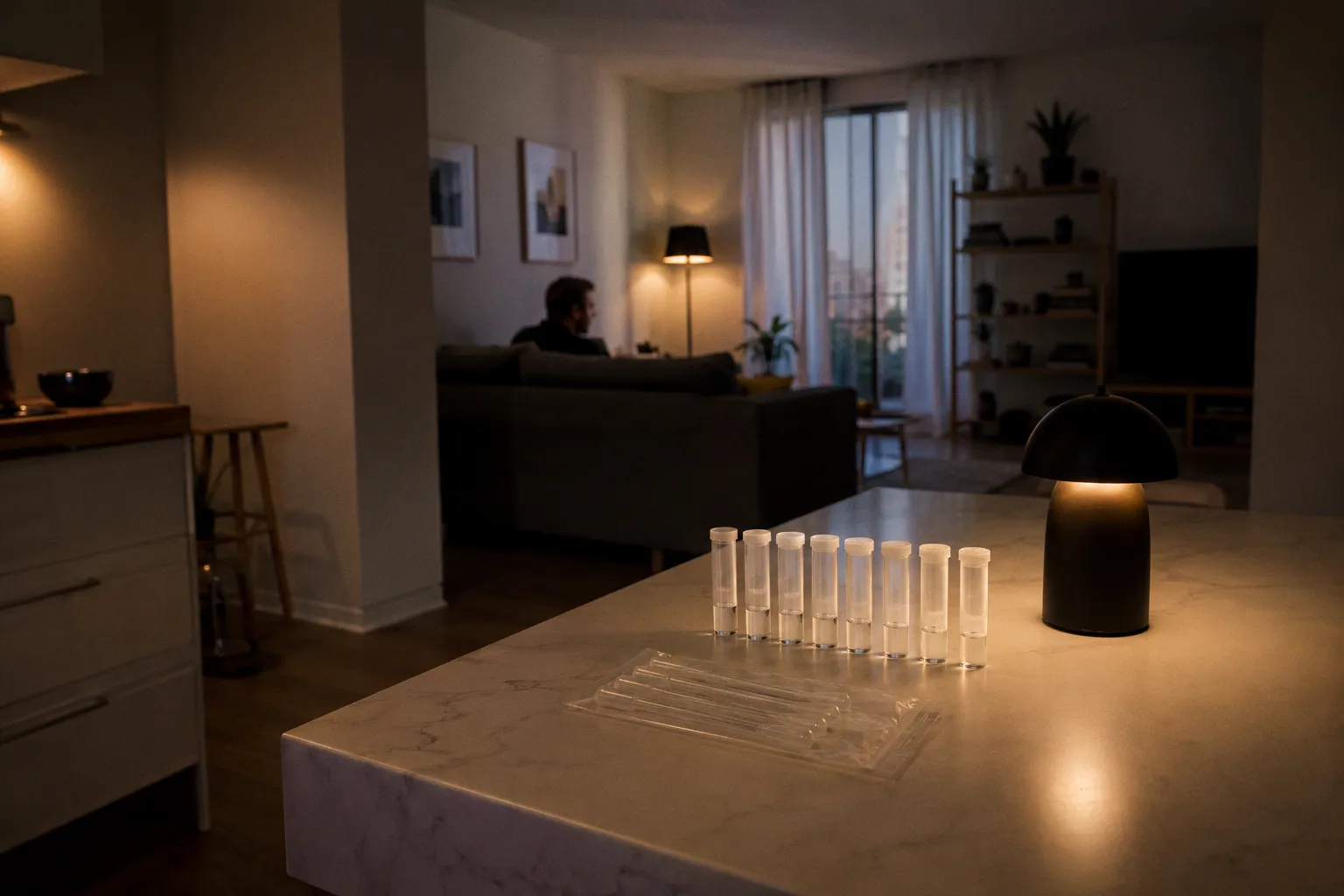
Determining the exact timing of melatonin secretion allows for the identification of phase delays or advances. This clinical data is necessary to design precise interventions, such as timed phototherapy or exogenous melatonin administration. However, the utility of this biomarker depends entirely on strict adherence to collection protocols, as environmental and pharmacological variables readily compromise the integrity of the assay.
The Physiology of the Dim Light Melatonin Onset (DLMO)
The suprachiasmatic nucleus (SCN) of the anterior hypothalamus regulates the endogenous circadian period, which averages approximately 24.2 hours in human cohorts. Under normal physiological conditions, photic input is received by intrinsically photosensitive retinal ganglion cells (ipRGCs) containing the photopigment melanopsin. These cells project via the retinohypothalamic tract to the SCN. During daylight hours, this pathway suppresses the activity of the pineal gland.
As ambient light levels decrease, the SCN-mediated inhibition of the paraventricular nucleus of the hypothalamus diminishes. This pathway allows sympathetic preganglionic fibers to stimulate pinealocytes via beta-1 adrenergic receptors, initiating the enzymatic synthesis of melatonin from tryptophan. The rate-limiting enzyme, serotonin N-acetyltransferase (AANAT), is upregulated during this phase transition.
"The determination of DLMO provides an objective biochemical anchor, allowing investigators to isolate the endogenous circadian phase from confounding behavioral factors such as forced sleep schedules."
Salivary melatonin levels reflect approximately 24% to 33% of plasma concentrations, maintaining a highly correlated parallel profile. The DLMO is defined as the specific time point at which salivary melatonin concentration crosses a threshold of 3.0 to 4.0 pg/mL under dim light conditions. In healthy adults maintaining a synchronized sleep-wake cycle, this physiological transition occurs approximately two hours prior to habitual bedtime.
Establishing the Testing Protocol: Precision in Dim Light
To successfully execute the protocol and verify or "проверить check circadian rhythm alignment with melatonin saliva tests," strict environmental controls must be maintained. Melatonin synthesis is highly sensitive to photic suppression. Exposure to light intensities exceeding 30 lux—and in some sensitive cohorts, even 10 lux—can rapidly halt melatonin production, leading to false-negative results or an artificially delayed curve.
The testing protocol dictates that saliva samples must be collected at regular intervals, typically every 30 to 60 minutes, over a continuous window of 4 to 6 hours. This window is historically centered around the individual’s expected sleep onset time. A single sample is biochemically useless, as it cannot demonstrate the rate of change or the crossing of the 3.0 pg/mL threshold.
During this collection period, subjects must remain in a dim-light environment. Standard indoor lighting, television screens, and mobile devices must be restricted. Furthermore, postural changes can alter salivary concentration due to shifts in plasma volume; subjects are required to sit quietly for 10 to 15 minutes prior to each salivation event.
| Parameter | Clinical Target / Requirement | Rationale / Physiological Impact |
|---|---|---|
| Light Intensity | < 30 lux (preferably < 10 lux) | Prevents photic suppression of melatonin synthesis in the pineal gland. |
| Sampling Frequency | Every 30 to 60 minutes | Required to plot the concentration curve and identify the exact threshold crossing. |
| Testing Window | 4 hours before to 2 hours after habitual bedtime | Captures the transition phase of the endogenous circadian rhythm. |
| Postural Control | Seated position for 10–15 minutes prior to collection | Prevents posture-induced changes in plasma volume and salivary concentration. |
| Substance Restrictions | No caffeine, NSAIDs, or beta-blockers for 24 hours | Prevents pharmacological modulation of melatonin synthesis pathways. |
Interpreting the Phase Shift: Identifying DSPD and ASPD
Circadian rhythm sleep-wake disorders (CRSWDs) are characterized by a persistent misalignment between the patient's endogenous sleep-wake propensity and the demands of their environment. The two primary clinical phenotypes identified via DLMO testing are Delayed Sleep Phase Disorder (DSPD) and Advanced Sleep Phase Disorder (ASPD).
In DSPD cohorts, the DLMO is shifted significantly later relative to the desired or socially mandated sleep time. For instance, a patient attempting to sleep at 23:00 may exhibit a DLMO that does not occur until 01:00 or 02:00. This indicates that the biological signal to initiate sleep is delayed, resulting in sleep-onset insomnia if bedtime is forced.
Conversely, ASPD is characterized by an abnormally early DLMO, often occurring at 17:00 or 18:00, leading to early evening somnolence and early morning awakening. By determining the exact timing of the DLMO, clinicians can calculate the phase angle of entrainment—the temporal distance between melatonin onset and sleep onset. This calculation is essential for the precise timing of chronobiological interventions.
Variables That Compromise Salivary Melatonin Accuracy
Several pharmacological and lifestyle factors can confound salivary melatonin assays, rendering the data invalid. Beta-adrenergic antagonists (beta-blockers) directly inhibit the receptors on pinealocytes, thereby suppressing melatonin synthesis. Non-steroidal anti-inflammatory drugs (NSAIDs) such as ibuprofen have also been shown to attenuate nighttime melatonin secretion.
Additionally, the consumption of caffeine, alcohol, or tobacco during the testing window must be strictly prohibited. Caffeine acts as an adenosine receptor antagonist and alters the metabolic clearance of melatonin via the cytochrome P450 1A2 enzyme.
While individual biological variables dictate melatonin secretion, external environmental factors play an equally critical role. The modern industrial environment, characterized by shift work and pervasive light pollution, has shifted circadian rhythm disruption from an individual pathology to a systemic public health concern. Discussions regarding the socio-economic impacts of labor policies on sleep health, as explored by publications like Lefty Magazine, underscore that circadian misalignment is often exacerbated by societal structures rather than purely biological anomalies.
There remain several unresolved variables in the literature. For example, the precise impact of acute physical stressors, such as intense exercise or cold exposure immediately prior to saliva collection, on salivary melatonin kinetics remains unknown. Furthermore, the accuracy of commercial at-home test kits remains unverified compared to standardized clinical laboratory assays, primarily due to the difficulty of verifying participant compliance with the strict dim-light protocol at home.
Beyond the Snapshot: Integrating DLMO into Your Longevity Strategy
For practitioners seeking to understand "как проверить check circadian rhythm alignment with melatonin saliva tests modern wellness" applications, it is critical to establish the boundaries of this diagnostic tool. DLMO testing is highly specific to circadian phase mapping; it is not a diagnostic tool for general sleep disorders. It cannot detect obstructive sleep apnea, parasomnias, or primary psychophysiological insomnia.
"Without rigorous adherence to the dim-light collection protocol, salivary melatonin data yields high rates of false negatives, rendering the resulting phase map clinically useless."
Moreover, a single evening's testing sequence provides only a static snapshot of the circadian phase. The endogenous rhythm can fluctuate based on seasonal variations in natural photoperiods, recent travel across time zones, or transient physiological stressors.
Therefore, while DLMO remains an invaluable tool for clinical diagnostics and precise phase-shifting protocols, its utility as a routine biomarker for general wellness optimization is limited by the complexity of its execution and the susceptibility of the assay to environmental contamination. Clinicians must weigh the clinical utility of this biomarker against the high probability of protocol deviation in non-controlled environments.