Schedule Skin Phototherapy by Circadian Clock for Efficacy
The question I kept returning to during my own experiments with a red-light panel was uncomfortably specific: at what point in my day was the light actually doing the most work?
Jessica Clayton·Updated: June 30, 2026·12 min read
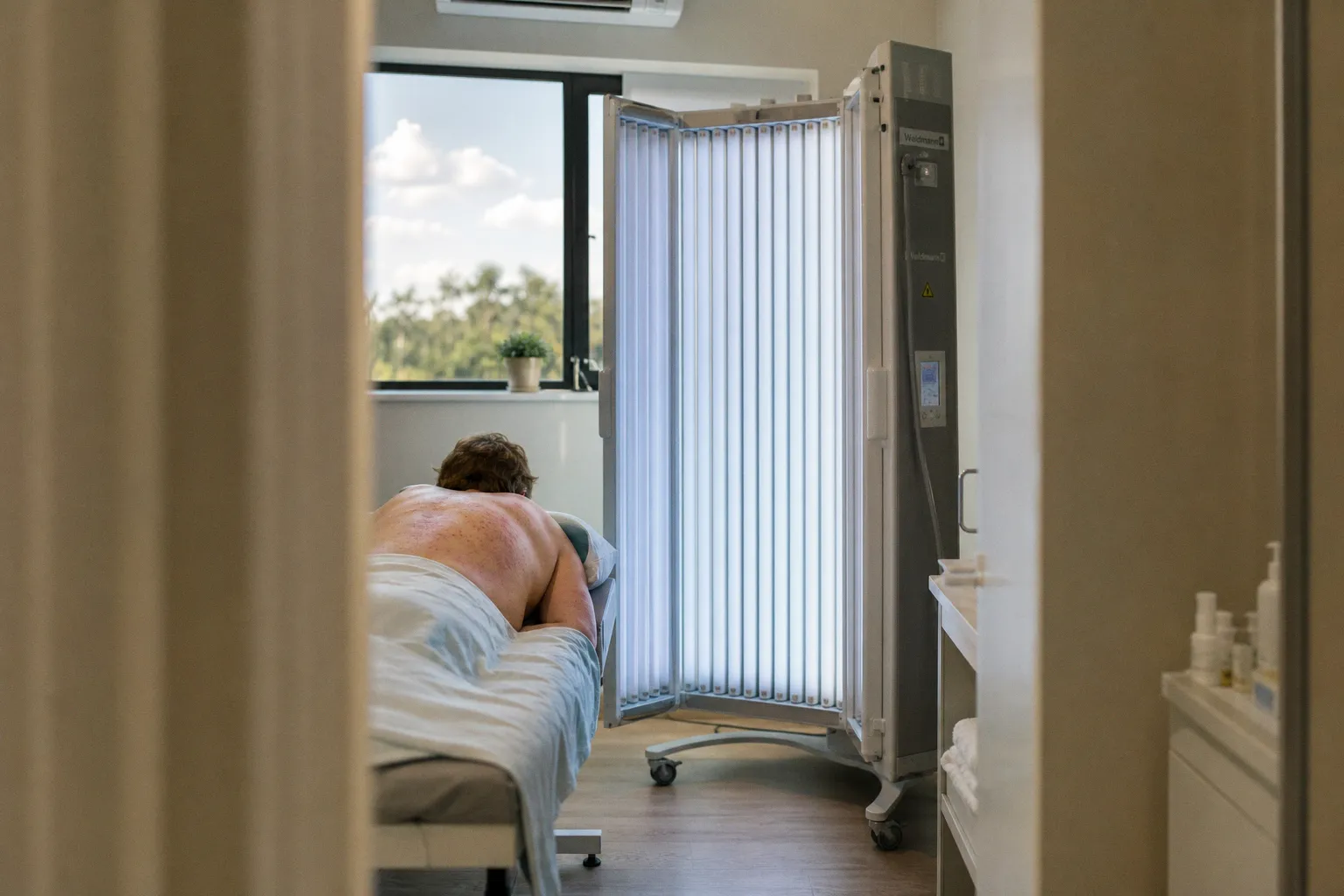
The Autonomous Clock Humming Beneath Your Skin
What we are really asking is whether chronotherapy — the discipline of dosing medical interventions according to biological rhythms — has anything useful to say about a light-based skin treatment. The short answer, increasingly, is yes. The longer answer is the one worth sitting with, because it changes how the treatment feels in the body, not just what it does on the surface.
A second oscillator, written into keratinocytes
Every cell in your body carries a molecular clockwork: a transcription-translation feedback loop involving genes like PER1, PER2, BMAL1, and CLOCK, ticking on a roughly 24-hour cycle even in the absence of external cues. For years, the central clock in the suprachiasmatic nucleus of the hypothalamus got most of the attention, since it was the one most obviously synchronized to the light-dark cycle through the eyes. But peripheral clocks exist in nearly every tissue, and the skin is unusually rich in them.
Keratinocytes, fibroblasts, and melanocytes — the three cell types that dominate the epidermis and dermis — each maintain autonomous circadian oscillators. These local clocks regulate, among other things, DNA repair activity, cell cycle progression, and the integrity of the permeability barrier. The skin is, in effect, a 24-hour instrument, with certain functions cresting in the morning, others in the evening, and still others in the quiet hours between sleep cycles.
The skin is not a passive canvas. It is a timed organ, and its receptivity to light rises and falls like a tide.
This matters because phototherapy — whether narrowband UVB for psoriasis, blue light for acne, or red and near-infrared panels for collagen support — works by delivering photons that interact with specific cellular machinery. If that machinery is more or less available depending on the hour, the same dose of light may produce meaningfully different outcomes. The implication is not subtle. The implication is that the clock on the wall might be as important as the wattage on the panel.
The Barrier's Own Quiet Schedule
Of all the rhythms in the skin, the one most useful to a person scheduling their own treatment is the rhythmicity of the permeability barrier itself. The stratum corneum — that thin, brick-and-mortar outermost layer that keeps water in and irritants out — is not equally competent across the 24-hour day.
Transepidermal water loss (TEWL), the standard metric dermatologists use to assess barrier integrity, fluctuates significantly across the day. In most healthy adults, the barrier reaches its lowest functional state in the late afternoon and evening, which is to say: water escapes more easily, irritants penetrate more easily, and the skin's defenses are at their most porous. By early morning, after a full night of repair, the barrier is comparatively restored.
What does this mean for someone stepping in front of a therapeutic light? Several things, and they pull in slightly different directions.
First, if the goal of a session is to deliver photons deep into the dermis — as with red and near-infrared light aimed at fibroblasts and mitochondria — barrier permeability may actually be a help rather than a hindrance. A slightly more permeable stratum corneum in the evening might allow longer-wavelength light, which already penetrates well, to reach its target cells with marginally less obstruction. There is research, still early, suggesting that fibroblast activity peaks during certain night-time intervals, which would align neatly with evening phototherapy sessions for collagen-targeted work.
Second, if the treatment involves wavelengths that act on the surface or shallow epidermis — blue light for acne, narrowband UVB for inflammatory conditions — the calculus changes. Here the more permeable barrier of evening might mean more erythema, more dryness, more of the side effects clinicians try to manage. For these protocols, a morning or early afternoon session may be kinder to the skin, even if the deeper cellular targets are less awake.
| Treatment Goal | Skin State Favored | Practical Timing Window |
|---|---|---|
| Red/NIR for collagen, fibroblast activity | Slightly permeable barrier, fibroblast-active phase | Late afternoon to early evening |
| Blue light for acne (surface bacteria) | Intact barrier to reduce irritation | Morning to early afternoon |
| Narrowband UVB for psoriasis or eczema | Stable barrier, lower erythema risk | Midday, when barrier is near its most competent |
The table is not a prescription. It is a way of holding several truths at once: that timing, wavelength, and skin condition all matter, and that rigid protocols miss the music of the system.
DNA Repair and the Quiet Hours
The mechanism I find most moving — and the one that has genuinely changed how I think about scheduling my own sessions — is DNA repair. Specifically, the circadian oscillation of nucleotide excision repair (NER), the pathway responsible for clearing the bulky lesions that ultraviolet light leaves behind.
NER does not run at constant strength. In many cell types, its activity peaks during the night and the early morning hours, when the skin is otherwise at rest and the cell cycle is calibrated for repair rather than proliferation. This makes biological sense: the dark hours are when DNA damage from the previous day's UV exposure is most abundant, and evolution would favor a repair crew that shows up to match.
Phototherapy sessions, especially those involving UVB, do add to that damage load. The therapeutic benefit in conditions like psoriasis comes in part from controlled DNA damage that resets runaway immune signaling. But the body's ability to clean up after that damage is not equally distributed across the day. A session delivered when NER is gearing up for its night shift may be better tolerated, with faster recovery and less cumulative burden on the genome.
Pair the light with the repair crew. The cells know when they are most ready to mend.
This is where the chronotherapy literature gets genuinely interesting, and where the evidence base is still young. Studies from the past decade have begun to explore whether narrowband UVB delivered at certain times of day produces less erythema for the same clinical effect, or whether the therapeutic window can be widened by dosing in alignment with the skin's own repair rhythms. The results are not yet strong enough to rewrite clinical guidelines, but they are consistent enough to suggest that the question is no longer whether timing matters, but how to use it.
Erythema, Side Effects, and the Geometry of a Gentler Dose
Anyone who has stood in front of a phototherapy unit, even briefly, knows that the skin's response is not always comfortable. Erythema — that flushed, warm, sometimes stinging reaction — is the most visible sign that the dose was higher than the skin wanted, and it is the side effect clinicians most carefully titrate against.
Circadian alignment offers a way to think about erythema differently. If the skin's inflammatory signaling is itself rhythmic — and it is, with cytokines and prostaglandins cycling across the 24-hour day — then the same dose of light arriving at different times may provoke different inflammatory responses. The early literature suggests that evening and night-time UVB sessions can produce more pronounced erythema than morning sessions, even at equivalent doses, which tracks with the broader inflammatory milieu of the evening skin.
For someone self-administering at home — and home red-light panels, blue-light masks, and other consumer phototherapy devices are now genuinely common — this has practical implications. A session timed to coincide with the skin's lower inflammatory tone, typically mid-morning to early afternoon, may produce a quieter post-treatment experience. A session timed to the evening, when inflammation is naturally elevated, may feel harsher and recover more slowly.
There is a second consideration here, less obvious but worth holding in mind. Sleep itself is a recovery state for the skin, with growth hormone secretion, cellular cleanup, and barrier restoration all peaking during deep sleep. A phototherapy session scheduled within a few hours of bedtime may interfere with that recovery in subtle ways — not through any direct effect of the light, but through the inflammatory and cortisol-modulating consequences of acute skin stress. The cleanest scheduling principle, when it can be managed, is to give the skin several hours between treatment and sleep, so that the recovery work happens on its own schedule, uninterrupted.
Chronotypes, Clinical Practice, and the Limits of a Universal Schedule
Here is where I want to slow down, because the evidence is genuinely thin and the temptation to over-prescribe is real.
The studies I have been drawing on are predominantly performed on adults with relatively conventional sleep-wake schedules, often in clinical populations whose chronotype has not been carefully characterized. Chronotype — that stubborn personal fact of whether you are a morning lark or a night owl — profoundly affects the phase of every peripheral clock in the body, including the skin's. A "morning" phototherapy session for one person may, in cellular terms, be happening at the same biological hour as an "evening" session for someone else.
What this means in practice is that any timing recommendation has to be a starting point, not a destination. For someone with a delayed sleep phase — who falls asleep well after midnight and wakes late — the skin's repair peak is shifted later as well, and a rigid mid-morning session may not align with their cellular readiness at all. The honest version of chronotherapy for skin phototherapy is one in which the timing is individualized, ideally informed by sleep diaries or, where available, by dim light melatonin onset testing in a clinical setting.
There is also a constraint worth naming. Most clinical phototherapy for serious skin conditions — psoriasis, severe eczema, vitiligo, cutaneous T-cell lymphoma — is administered in supervised settings, often multiple times per week over months. The schedule is dictated as much by clinical logistics and equipment availability as by biology. Asking patients to also time their sessions to an ideal biological window is, in many healthcare systems, simply not feasible. Where chronotherapy has the most room to operate is in the consumer space — at-home red-light panels, blue-light masks, low-level laser devices — where the user controls the timing.
Shift work, jet lag, and the broader category of circadian misalignment are not abstract concerns. They are lived conditions — for night-shift nurses, long-haul drivers, and the growing population whose work happens across time zones. Even outside of work, modern life is full of light exposures that arrive at the wrong biological hour: the blue glow of an infotainment screen during a midnight drive, for instance, or the ambient LED cabin lighting that has become standard in newer vehicles. Each is a small input into the skin's clock, and over months and years, these inputs accumulate. Treating the skin with phototherapy on top of an already-disrupted rhythm is, in a sense, asking it to do careful work on a foundation that is itself unsteady.
| Personal Factor | Effect on Skin Clock | Practical Adjustment |
|---|---|---|
| Morning chronotype | Peaks shifted earlier | Earlier sessions well-tolerated, evening sessions may feel harsher |
| Evening chronotype | Peaks shifted later | Late afternoon or early evening may align better than mid-morning |
| Shift work or sleep loss | Circadian misalignment, impaired barrier recovery | Prioritize sleep repair first; treat on days off when possible |
| High stress or allostatic load | Dampened circadian amplitude | Lower doses, gentler wavelengths, more forgiving timing |
The table is, again, not a protocol. It is a way of holding the variables in mind without freezing them.
A Grounded Way Forward
What I have taken from months of paying attention to my own skin under timed light is something quieter than a protocol and more useful than a rule. The skin is rhythmic. The light is rhythmic. The interaction between them is, in a very real sense, a duet, and duets work best when both players are listening.
If you are using a home phototherapy device, the most respectful place to start is not the manufacturer's recommended schedule but your own wake-sleep pattern. Anchor your sessions to a consistent time of day, give yourself at least two to three hours before sleep, and pay attention to how your skin feels and looks the morning after. If the post-treatment erythema is sharper on evening sessions, shift earlier. If your skin feels more responsive on morning sessions, stay there. The body will tell you, if you let it.
For anyone navigating clinical phototherapy for a diagnosed skin condition, the conversation to have with a dermatologist is different: ask whether timing has been considered, whether your chronotype has been characterized, and whether the protocol could be adjusted to align with your sleep. It is a reasonable question, and increasingly, it is one clinicians are equipped to engage with.
The deeper shift, I think, is from optimization to attunement. We do not need to dominate the skin's clock, or hack it into submission, or crush its rhythms into a more productive shape. We need to listen to it, schedule around it where we can, and recognize that the timing of a treatment is not a footnote to the dose. It is part of the dose. The skin has been keeping time, patiently, for as long as it has existed. The least we can do is meet it on its own schedule.