Is a chromium supplement for insulin sensitivity worth buying?
A muscle cell's membrane is a stubborn gatekeeper. Glucose knocks, insulin turns the lock, and a small protein called GLUT4 slides up to carry the cargo inside.
Jessica Clayton·Updated: July 04, 2026·7 min read
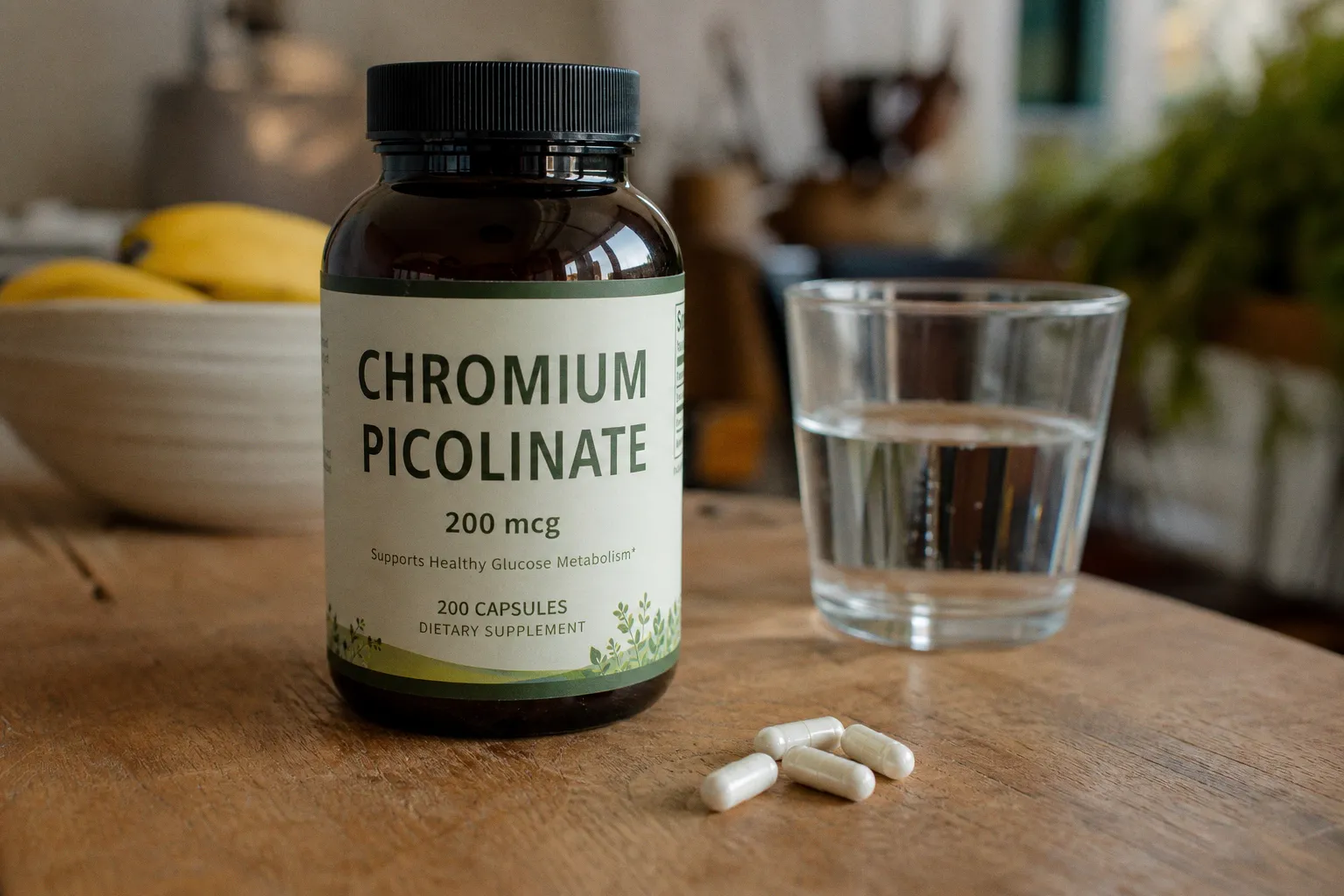
The mechanism: what chromium is thought to do at the membrane
Insulin signaling is a cascade, not a switch. The hormone binds its receptor on the cell surface, the receptor auto-phosphorylates, downstream kinases activate, and — at the end of the chain — vesicles carrying GLUT4 proteins migrate to the membrane and dock there, opening channels for glucose to enter muscle and fat tissue. The whole sequence has its own tempo, and each step has its own sensitivity to disruption.
Chromium is thought to enhance this sequence at its most upstream, most decisive point. The working hypothesis runs through a small peptide called chromodulin: chromium binds it, the complex amplifies insulin receptor activity, and as a result GLUT4 translocation becomes more efficient. In simpler terms, the mineral is thought to lower the resistance of the lock, so the door opens more reliably when insulin arrives at the cell.
This is mostly a story told by cell-culture and animal work, with thinner human confirmation. But the molecular hypothesis is what separates a serious supplement for insulin sensitivity from a generic metabolic claim. There is a defined target — the insulin receptor, the GLUT4 traffic — and a defined, testable role. Whether the dose a person actually takes produces enough of that effect to move a clinical number is a separate, harder question.
What the clinical evidence actually shows
The cleanest signal in the literature comes from a 2020 meta-analysis pooling randomized controlled trials in patients with type 2 diabetes. Across those studies, chromium supplementation — predominantly chromium picolinate, predominantly at doses well above the adequate intake — was associated with statistically significant reductions in HbA1c and fasting plasma glucose. The phrase "statistically significant" is doing real work here: this isn't anecdote, and it isn't a single outlier trial.
The magnitude, however, is modest. We're talking about meaningful but not dramatic shifts, the kind of effect that registers on a clinician's lab sheet without fundamentally changing the trajectory of the disease. That distinction matters, because the same supplement is often marketed with a much louder promise than the data supports.
A supplement for insulin sensitivity can tune the existing instrument. It cannot replace the player.
For metabolically healthy people, the picture is murkier. Trials in overweight or non-diabetic populations have produced inconsistent findings — some show small improvements in insulin sensitivity, others detect nothing meaningful. The honest reading is that the strongest signal appears where the most biology is plausibly in play: among people whose glucose regulation is already off-rhythm. For someone whose fasting glucose is comfortably in range and whose CGM curves are flat and narrow, the supplement isn't addressing anything measurable, and there's no signal to amplify.
Bioavailability, and why picolinate dominates the literature
Chromium is sold in several forms: chromium chloride, chromium nicotinate, chromium picolinate. The picolinate form is the workhorse of the clinical evidence, and the reason isn't accidental. Picolinate appears to improve bioavailability — the fraction of the dose that actually reaches circulation after you swallow the pill.
That difference is rarely explained on supplement labels, and it was one of the first things I checked when I started reading bottles. If you want to reason from the science to your own decision, the science mostly tested picolinate. Other forms aren't necessarily inactive, but they have thinner evidence behind them, and "thinner evidence" is rarely a place a cautious reader wants to anchor a routine.
One consequence worth naming out loud: "more bioavailable" is a structural advantage, not a clinical guarantee. Picolinate is what the trials used, and that's why it's what most readers should consider if they're trying to map their choices onto what the literature actually measured.
Navigating dosage: from baseline nutrition to clinical ranges
The Adequate Intake (AI) for chromium is set low: 35 mcg per day for adult men, 25 mcg per day for women aged 19 to 50. These numbers reflect what the body needs to maintain baseline function, not what a supplement might shift on a lab printout.
Clinical trials use a much wider range — typically 200 to 1000 mcg per day of chromium picolinate, sometimes split across multiple doses. The gap between baseline nutrition and clinical practice is meaningful, and it's worth seeing laid out:
| Reference point | Chromium dose | Context |
|---|---|---|
| AI, adult men (19–50) | 35 mcg/day | Baseline nutritional need |
| AI, adult women (19–50) | 25 mcg/day | Baseline nutritional need |
| Typical clinical trial range | 200–1000 mcg/day | Chromium picolinate, mostly T2D populations |
| Common OTC supplement dose | 200 mcg/day | Standard over-the-counter picolinate products |
If you're taking a 200 mcg pill, you're consuming roughly six to eight times the adequate intake for an adult woman. That's a meaningful gap, especially because the long-term safety of sustained high-dose chromium intake isn't well-mapped in the research. There is no established Tolerable Upper Intake Level for chromium, owing to limited data on adverse effects from high oral doses — and that absence isn't an endorsement of safety. It reflects an honest gap in the evidence, one regulators haven't been able to close with confidence.
For anyone thinking about daily, long-term use, that's a gap worth raising with a clinician, particularly if you're on medications that already affect glucose or insulin. The general rule I'd hold to: don't assume a higher dose buys you a bigger effect. The trial evidence doesn't support a clean dose-response curve, and pushing past the studied range offers diminishing returns and rising uncertainty.
Who actually benefits, and the limits of "supportive"
This is the part of the picture I keep returning to. If your metabolic rhythm is already intact — fasting glucose in range, HbA1c on target, post-meal glucose curves narrow and short — chromium has little measurable terrain to work on. The biology doesn't have much slack to take up, and the supplement has nothing substantial to amplify.
The case becomes more defensible when the rhythm is already disturbed: prediabetes, insulin resistance, type 2 diabetes under medical care. There, chromium picolinate can play a small, supportive role alongside the heavier interventions — diet composition, regular movement, sleep continuity, stress modulation, and any medication a clinician has prescribed. Calling it "supportive, not primary" feels like the most accurate framing available, and it's the one I'd trust.
The mineral amplifies a signal that already exists. If the signal is weak, the amplification is small. If the signal is already strong, you don't need the amplifier. Anyone treating chromium as metabolic insurance is reading the biology backward — it doesn't generate benefit out of nothing; it tunes a system that already has a defined metabolic question to answer.
Where this leaves me
I'm six months into my own quiet experiment. I take 200 mcg of chromium picolinate most days, alongside protein-forward meals, walks after dinner, and a sleep routine I'm still, slowly, learning to defend against late-night emails and the gravitational pull of open tabs. My CGM data showed a slight tightening of post-meal curves, and I wanted to keep that curve in its new shape. I try to call that what it is — a small nudge on top of the larger variables that actually move the numbers.
I also think metabolic optimization has a quiet tendency to over-promise on single nutrients. The real variable isn't which pill lands in your routine; it's whether your life has built a setting in which any supplement could matter at all. Chromium has a real mechanism, real but modest trial data, and a real place in the conversation about supplements for insulin sensitivity — but only as a member of the ensemble. Never as the soloist.
The question isn't whether chromium works in principle. It's whether your metabolic rhythm needs a single small amplifier — or a larger reset.