Track Glucose with CGM Sensors or Traditional Glucometers
We’ve been conditioned to believe a single data point is a truth. A number on a screen, a reading from a device, and we think we’ve mapped the territory. But in metabolic health, this is a dangerous simplification.
Marcus Thorne·Updated: June 05, 2026·7 min read
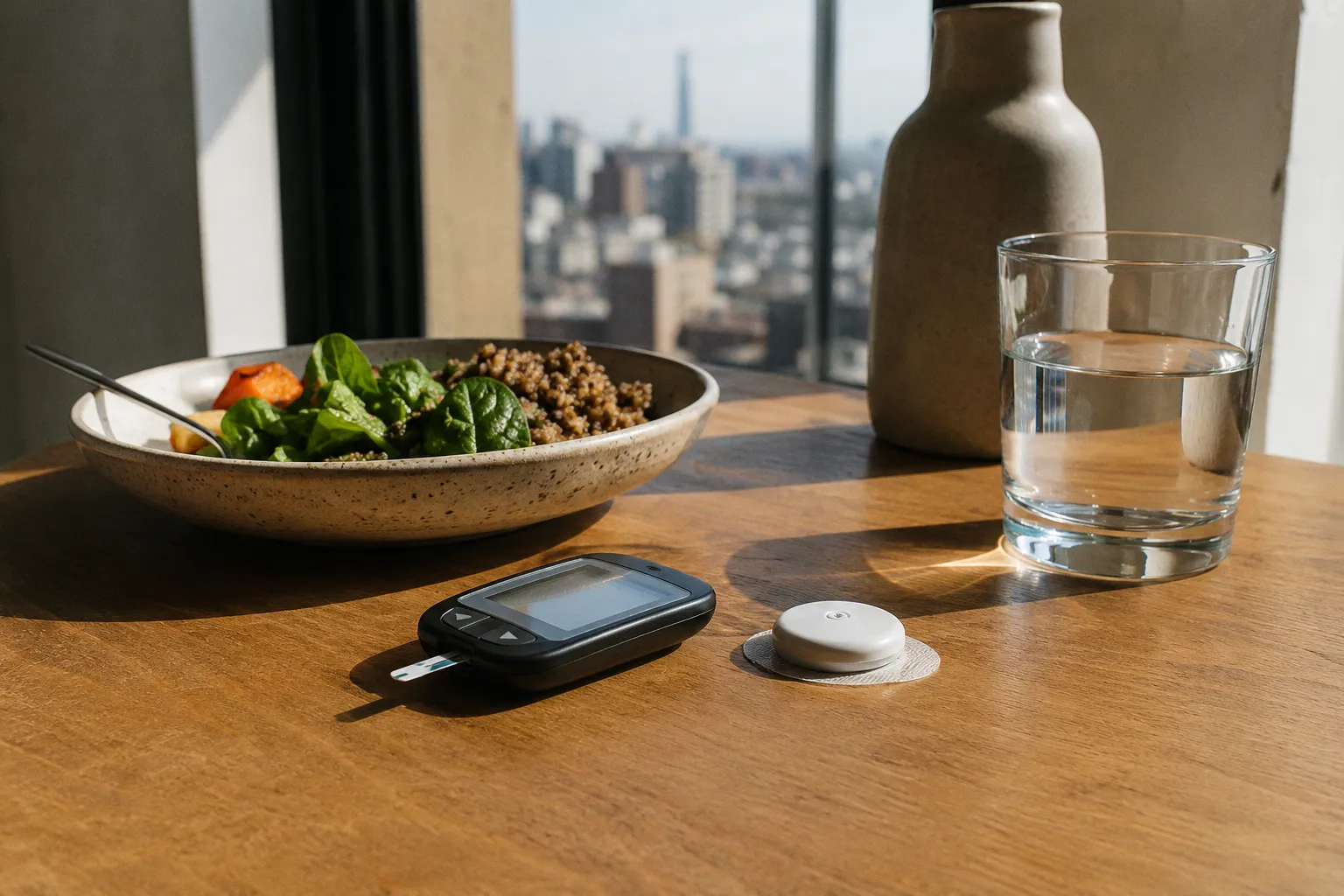
The Snapshot Illusion
The core leverage point here isn’t choosing the "best" tool. It’s understanding the fundamental asymmetry between what each tool measures and, more importantly, what that measurement *means* for your system.
The Mechanics of Measurement: Interstitial Fluid vs. Capillary Blood
The distinction starts at the molecular level. A traditional glucometer, or self-monitoring of blood glucose (SMBG), works on a direct principle: a lancet draws a drop of capillary blood, a reagent strip reacts, and an electrochemical signal is quantified. The output is a discrete, point-in-time concentration of glucose in your blood. It’s a required input for medical calibration and a direct validation of what’s happening in your bloodstream *right now*.
A Continuous Glucose Monitor (CGM) operates on a different logic. A subcutaneous sensor, typically in the arm or abdomen, measures glucose in the interstitial fluid (ISF)—the fluid that surrounds your body’s cells. This is a critical, indirect proxy. The glucose molecules diffuse from your capillaries into this fluid, and it’s this diffusion that creates the system’s inherent friction.
This isn’t a flaw; it’s physics. The lag time between a change in your blood glucose and the corresponding change in your interstitial fluid is typically 5 to 15 minutes. You’re not reading the source signal directly; you’re reading a highly correlated, slightly delayed echo. Understanding this lag is non-negotiable for interpreting data correctly.
Decoding Glycemic Variability Through 288 Daily Data Points
Here’s where the architectural difference becomes stark. Your traditional meter might give you 4 to 10 data points on a good day—before meals, after meals, upon waking. That’s a sketch.
A CGM, generating up to 288 readings per day (one every 5 minutes), provides the full landscape painting. You see not just the peaks and troughs, but the shape of every climb, the gradient of every descent, and the stability of every plateau. This torrent of data is the only accurate input for calculating glycemic variability—the rollercoaster of glucose swings throughout your day.
High glycemic variability is a key marker of metabolic stress and future risk. It’s a pattern of repeated glucose surges followed by reactive drops, often invisible to spot-checking. You might see a "normal" fasting glucose of 90 mg/dL on your morning finger-prick and feel validated. But a CGM might reveal you spent three hours overnight dipping into the 60s, followed by a sharp spike to 160 mg/dL after your "healthy" oatmeal breakfast. That’s a system under strain. Only continuous data exposes these hidden frictions in your metabolic engine.
You cannot optimize a system you cannot see. A glucose snapshot shows you the weather; a CGM trend shows you the climate.
Navigating the 15-Minute Lag and Sensor Accuracy Benchmarks
Let’s operationalize the lag. It becomes most consequential during rapid changes—like after a high-intensity interval workout or during a hypoglycemic episode. If your blood sugar is plummeting post-exercise, your CGM will reflect that drop 5-15 minutes later. During that window, you might feel shaky or fatigued (symptoms driven by blood glucose), while your sensor still shows a stable, comfortable number. Relying solely on the sensor in that acute moment would be a mistake.
Accuracy is another key input for your mental model. The industry benchmark for CGM performance is the Mean Absolute Relative Difference (MARD). A MARD of 15% or lower is considered good. This means if your true blood glucose is 100 mg/dL, the CGM reading could be between 85 and 115 mg/dL. This is more than sufficient for identifying trends and patterns over days and weeks—the strategic, long-game view. For tactical, moment-to-moment decisions (e.g., dosing insulin), capillary blood testing remains the required regulatory standard.
The system is designed for this integration. Modern integrated CGMs (iCGMs), a class approved since 2017, are built for non-adjunctive use, meaning they can be trusted for treatment decisions without a confirmatory fingerstick in many scenarios. This is a massive reduction in friction for users, but it doesn’t eliminate the need to understand the underlying mechanics.
Contextualizing Metabolic Flexibility Beyond the Glucose Spike
The most powerful output of CGM data is not just seeing your spike after a meal; it’s quantifying your metabolic flexibility—your body’s efficiency at switching between fuel sources and, crucially, how swiftly it restores equilibrium.
The key metric here is area under the curve (AUC) or simply, the time it takes for your glucose to return to baseline after a meal. A robust, metabolically flexible system will spike modestly and return to baseline within 90 to 120 minutes. A sluggish system will see glucose remain elevated for three, four, or more hours, keeping insulin levels chronically raised and signaling a state of metabolic inflexibility.
This is where you move from passive tracking to active system design. You begin to run personal experiments:
1. Isolate a variable. Eat the same meal with and without a 15-minute walk beforehand.
2. Measure the output. Compare the glucose AUC and return-to-baseline time from your CGM data.
3. Identify the leverage. The walk likely creates a 20-30% reduction in the glucose spike and shortens the recovery window. That’s a high-leverage input.
You’re no longer just "checking your sugar." You’re stress-testing dietary compositions, sleep hygiene, and stress management protocols against your unique physiology. The goal isn’t a "flat line"—some variability is natural and healthy—but understanding how your inputs map to your glucose outputs.
Strategic Integration: When to Rely on Snapshots versus Trends
This isn’t an either/or proposition. It’s a systems-thinking framework for tool selection based on the question you’re trying to answer.
| Question | Best Tool | Rationale |
|---|---|---|
| "What is my glucose right now for a medical decision?" | Traditional Glucometer (SMBG) | Provides a direct, regulatory-approved capillary blood measurement. Essential for immediate clinical action, insulin dosing, or sensor calibration. |
| "How does my body respond to this specific food or activity?" | CGM | The continuous stream (288 points/day) captures the full story of the spike, recovery, and variability, not just one moment. |
| "What are my nocturnal patterns and dawn phenomenon trends?" | CGM | Only a continuous device can monitor overnight without sleep disruption, revealing hidden trends like overnight lows or pre-dawn rises. |
| "How has my average glucose changed over the past month?" | CGM | Provides metrics like Time-in-Range (TIR) and average glucose that require continuous data collection. A traditional meter cannot. |
| "I feel shaky; should I treat for low blood sugar?" | Glucometer | In a potential acute hypoglycemic event, you need the immediate, direct measurement. The CGM's lag is too great a liability here. |
The strategic user builds a protocol. They might wear a CGM for a 2-week "deep dive" every quarter to establish their baseline metabolic landscape, identify problematic foods, and optimize routines. Between these deep dives, they use a traditional meter for spot-checks (fasting glucose) and acute situations. They reduce the friction of data collection while maximizing the utility of the data gathered.
This is the essence of pragmatic biohacking: not fetishizing the tool, but using the right input to generate the most actionable output for the system you’re trying to optimize.
Your metabolic health is not a number on a screen. It’s the resilience of the curve—the pattern of adaptation revealed over time.
The data is clear. The FDA cleared the first professional CGM back in 1999, and the consumer wellness space is now catching up to the technology's potential for non-diabetics. The target glycemic range for optimal metabolic health is widely considered to be between 70 and 140 mg/dL, spending minimal time at the extremes. But the journey to understanding your personal version of that range is not found in a single reading. It’s found in the architecture of your data.
Start your own 72-hour glucose audit. Eat your normal meals, live your normal life, but map it. See where the friction points are. That’s where the leverage for transformation begins.